
Hash tables
↑At a glance
Section titled “At a glance”A hash table maps a key to a bucket or slot. A suitable hash function helps distribute keys evenly. Typical lookup, insertion and deletion costs are O(1) on average, but collisions and resizing affect performance.
Hash functions and buckets
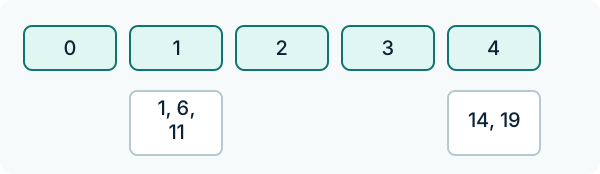
Section titled “Hash functions and buckets”A hash table uses a hash function to decide where to store an item. In this exercise, a simple modulus operation maps an ID to one of several buckets.
Interactive bucket simulator
Section titled “Interactive bucket simulator”Build a hash table
Change the bucket count, add your own IDs and watch collisions appear.
What happens during a collision?
Section titled “What happens during a collision?”A collision occurs when different keys map to the same bucket. Collisions are normal; they must be handled correctly. Common approaches include separate chaining and open addressing.
Complexity
Section titled “Complexity”| Operation | Average case | Worst case |
|---|---|---|
| Lookup | O(1) |
O(n) |
| Insert | O(1) |
O(n) |
| Delete | O(1) |
O(n) |
Two ways to handle collisions
Section titled “Two ways to handle collisions”Separate chaining stores multiple entries at the same bucket, often in a list or similar collection. Open addressing searches for a different available slot in the table. Both need to check keys for equality after hashing.
Load factor and resizing
Section titled “Load factor and resizing”A table with many stored keys relative to its number of buckets has a high load factor. More collisions become likely, so implementations often increase capacity and redistribute existing entries. Resizing is expensive when it happens, even if ordinary operations are fast on average.
Language examples
Section titled “Language examples”var ages = new Dictionary<string, int>();ages["Alex"] = 24;if (ages.TryGetValue("Alex", out int age)) Console.WriteLine(age);#include <unordered_map>#include <string>#include <iostream>std::unordered_map<std::string, int> ages;ages["Alex"] = 24;if (auto it = ages.find("Alex"); it != ages.end()) std::cout << it->second << '\n';Equality is part of hashing
Section titled “Equality is part of hashing”A hash code chooses a candidate bucket, but it does not prove that two keys are equal. A correct hash table checks key equality after locating candidates. Equal keys must produce equal hash codes under the chosen equality rules, while unequal keys are allowed to collide.
What resizing changes
Section titled “What resizing changes”As more items enter the table, average bucket occupancy tends to rise. A typical implementation allocates a larger bucket array and reassigns existing keys to new buckets. That operation can take O(n) at the moment it happens, even when average insertion cost over many operations is constant.
Practical key design
Section titled “Practical key design”Avoid mutable key fields that affect equality or hash codes while the key is stored. If a dictionary’s key changes without the table being updated, future lookups can fail. Prefer stable value objects or strings for identifiers.
Go deeper: implement the actual data structure
Section titled “Go deeper: implement the actual data structure”Start with the bucket calculation and equality rules, then work through collisions, reusable code, deletion and resizing. Try the simulator above before reading the implementation.
- Hash functions and collisions
- Build a hash table in C#
- HashSet vs Dictionary
- Open addressing
- Resizing and complexity